• About
  • My Games
  • My Stories

a little bit of everything all of the time

~ Thoughts on stuff and things.

a little bit of everything all of the time

Tag Archives: gaming

Succor Postmortem

15 Tuesday Apr 2025

Posted by abc in Game Design, Game dev, QA

≈ Leave a comment

Tags

game creation, Game Design, Game dev, game review, gamedev, games, gaming, postmortem, video-games

WARNING! SPOILERS FOR THE GAME INCLUDED IN THIS POST!

I’m quite excited to share this postmortem! 

 I’ve finally returned to Succor, a game initially made in a jam, and given it a major overhaul and update. I feel comfortable with where the game’s state is (though there’s always going to be a temptation to tinker more) and I’m happy to call it a finished, polished play experience. Most of my game creations are jam experiments, so it feels particularly nice to be able to put a stamp of “finished” on a game – one step further down the road in becoming a proper game dev!

Background

This game in particular feels a bit emotional to finish. Not only does the game cover rather deep and dark topics about trauma and memory, it’s my first coding project in nearly a year after struggling with major health setbacks. For many months, I couldn’t even sit at a computer, much less wrangle my brain into coding or writing extensively…but the final word count is around 20,000 words! Phew!

The original jam game was a small experiment in how traumatic memories can be sparked by things as mundane as reading a menu and encourages players to battle these demons by making either constructive or destructive choices. The new version has expanded on this concept, with many more additions to content.

Code and Design Updates

As this was a project created fairly early in my game dev journey, a lot of this code was a MESS and I spent a decent chunk of time focusing on behind the scenes things, such as creating widgets (Twine’s versions of functions) to streamline creation. Some old code I merely tinkered with a bit, as I didn’t want to get caught up in too much refactoring, as I didn’t want scope to run away from me. At the end of the day, this is an experimental text game, so “good enough” works for many things.

One major change I added was creating a function to track the game’s demons and adjust how demons were assigned to appear though the game. Originally, demons were simply tied to menus: browsing the menu for a bakery spawns a demon for addiction, for example. Our wonderful artist had created several additional pieces of artwork and I wanted to include these as well, so I ended up expanding out the available menus to give each demon one they were tied to. However, I felt simply adding more menus to the table would be a rather dull play experience, so I instead added several “hidden” menus players can find through cleaning the house, as well as some lurking demons triggered by the act of cleaning itself – and then to give the game a bit of replayability (because there are multiple endings and achievements), I decided to shuffle around where they were each new game.

<<set $demonsToDo = Array.from(setup.demons.list)>>
<<set $menusToDo = Array.from(setup.menus.list)>>

This code creates an array of all the potential choices for both demons and menus at the start of the game (storyInit as well as a resetVars widget which runs when the player returns to the main menu at the end of the game). It pulls these values from javascript objects.

setup.demons = {
    list: ["insecurity", "humiliation", "addiction", "loneliness", "abuse", "rage", "regret", "envy", "lethargy", "paranoia"],
...
}
setup.menus = {     list: ["indian", "pizza", "french", "sweets", "bbq", "italian", "chinese", "grill", "turkish", "cajun"],
...
}

It then plucks (randomly removes a value from the array) , creates different menu details and removes the demon associated with that particular menu. So if “sweets” was plucked, it would pick one of the random names for a restaurant (eg “The Sweet Tooth” or “Toothsome Temptations”) and also set the associated demon. 

<<set $menu1 = $menusToDo.pluck()>>
<<set $menu1name = setup.menus[$menu1].random()>>
<<set $menu1Demon = setup[$menu1].demon>>
<<run $demonsToDo.delete($menu1Demon)>>

NOTE: This code is one example of the “good enough” type of coding I was talking about above – if I were to continue work on this game, it would definitely be much more efficient to create a loop for this assignment, as well as a much better set of relationships for how I’m handling these values, for example something like an object to store all the different information about each menu. Since this was a continuation of a very old game when I was a lot newer at coding, I decided it was easier to just be a bit sloppy and finish the project using some of the existing framework instead of getting lost in the weeds optimizing.

Once the menus were built, the first 3 were assigned to the main table in the game. 4 more were tucked away to be found when the player finishes cleaning different parts of the house (for example, once a cupboard is fully clean, the player discovers a menu tucked away in the back), which leaves 3 more demons to spawn at random. The following code basically tracks how many actions the player has done and if they are above 20 actions, we spawn a demon:

<<widget "demonspawn>> 
    <<if $demonstodo.length > 0>>     
        <<set $movecount += 1>>     
        <<if $movecount > 20>>         
            <<set $movecount= 0>>         
            <<set $currentdemon= $demonsToDo.pluck()>>            
            <<dialog>>             
                <<print setup.demons[$currentdemon + $currentroom "1"]>> 
                <br><br>
                <<print setup.demons[$currentdemon + $currentroom "2"]>>             
                <<close>>       
                <<onclose>> 
                    <<goto $currentdemon>>    
            <</dialog>>    
        </if>> 
    </if>> 
<</widget>>

I then used this widget in any room/passage for activity where I wanted a demon to potentially spawn. For example, since there’s a menu hidden in the cupboard, I didn’t use demonspawn in those passages and instead just manually added to movecount. If I were to optimize this, I’d probably split the movecount and the spawning into 2 different widgets or make javascript code to apply to click events/passage navigation and just exclude the places I didn’t want it to run.

Some feedback I got from the early version of the game is that people didn’t realize there were variants of text for descriptions of items, as I had just been pulling text using .random, so I changed many of these messages to cycle, using the method of creating an array I outlined above. Halfway through changing all this over, I realized I could be a bit lazy and use this process to also cycle through the cleaning process. The code below will check for the size of the array and if it’s empty, it will set the bed to cleaned and execute cleaned logic (giving willpower, checking for an achievement for cleaning everything, etc). If there are still values left in the array, it will shift the array to remove the first element and display that.

setup.bed = {
...
clean: ["You begin by stripping the pillows and sheets - judging by the rather...err...ripe smells, it's far past time they were washed. You've just been so exhausted and haven't had the time, but now that you're doing it, you find yourself looking forward to having a chat with neighbors when you bring the laundry down tomorrow.", "You rummage in your tiny closet for spare sheets and pillowcases, dislodging an old box of photos. You spend some time glancing over better days and set aside a few photos from travels with old friends.", "You wrangle with the fitted sheet, starfishing on the mattress until you triumphantly manage to tuck in all four corners.", "You give your pillows a hopeful fluff and toss them atop the made bed. It's not the most luxurious sleeping arrangement, but it definitely looks a lot more inviting and restful than when you started."],
...
}
<<set $msgBedClean = Array.from(setup.bed.clean)>>
<<if $msgBedClean.length == 0>>
<<set $bedClean = 1>>
<<cleanDone>>
    <<dialog>>
<<include bedMenu>>
    <</dialog>>
<<set $msgBed = Array.from(setup.bed.cleanDone)>>
<<else>>
<<clean>>
<<print $msgBedClean.shift()>>

UI Updates

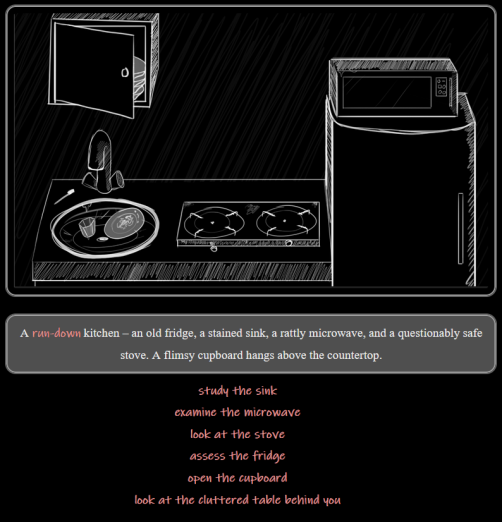
My goal with the UI update was to lean into the hand-drawn art’s sketchy style and create the impression of the images and text being words in someone’s journal (especially since a journal is an interactable object in the game, where you can even add custom entries!). I browsed the internet and found some useful codepen examples for the stacking pages and tape corners and tweaked those until I was happy. 

Original UI:
Updated UI:
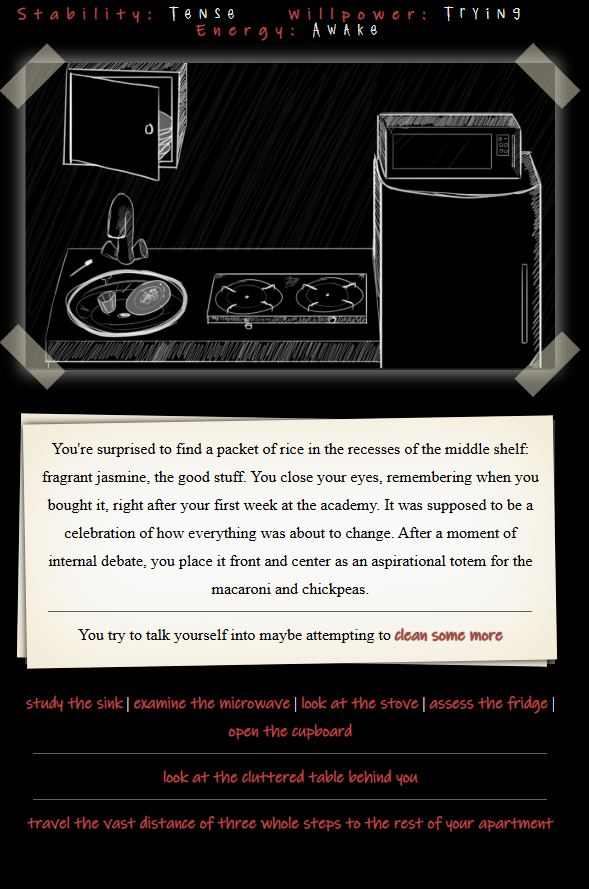
This is another “good enough” moment. I could keep improving the UI, but then I’ll end up down the CSS rabbithole for ages, so I basically had to stop myself and say “it looks fine.” I might go back and add a color-blind mode as I definitely think that might be a problem :/

Art Updates

The artist for this game had previously sent me some extra art they had done which we didn’t have time to add to the project during the jam, due to running out of time. I really wanted to be able to showcase these pieces, so I added in more ways for players to find demons as noted above. 

One issue I ran into is that our format for the menus used a header art image, so creating new menus without those would stand out a bit. 

Example menu page:
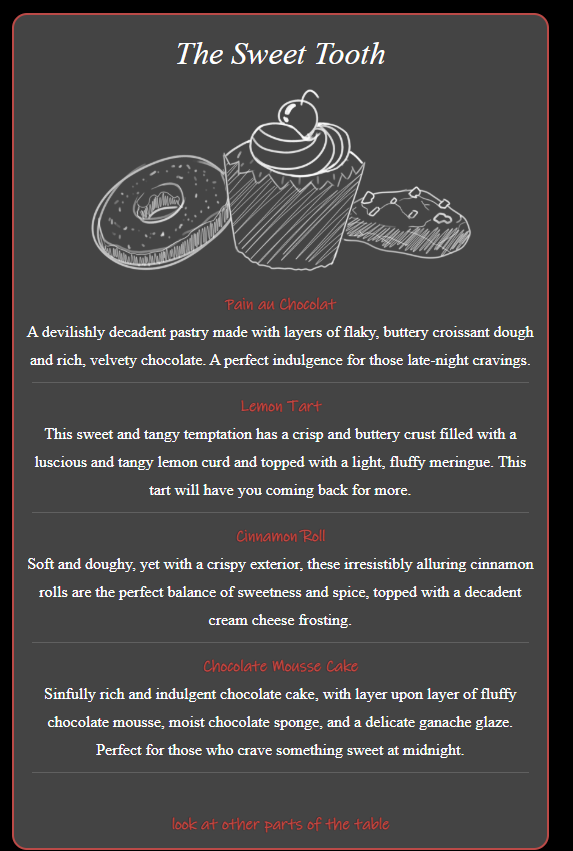
I first went through the existing art to determine if I could double-dip on any of the image. For example, the image of an outdoor grill for a bbq restaurant also worked great for a burger joint and by cutting out the distinctive pillars of the Taj Mahal (for our I ndian restaurant) I was able to have a mosque that kinda looked like the Hagia Sofia (for a Turkish restaurant). I began to run out of choices, however, until I realized the French image could make an easy shift to a logo for a cajun restaurant!
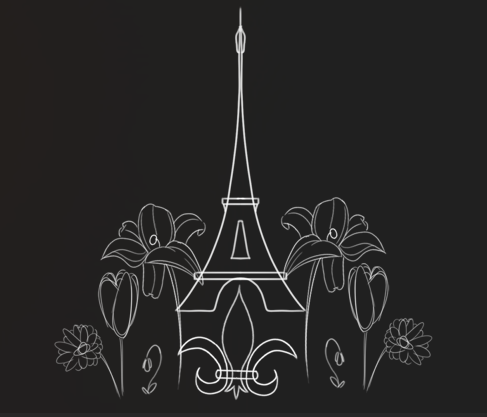
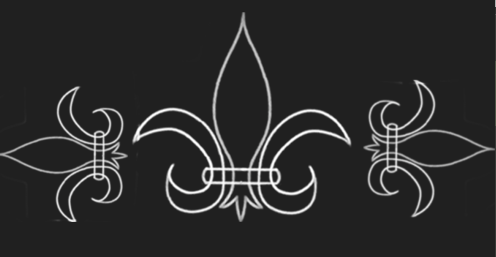
All I had to do was crop the fleur de lis, copy it and rotate the copies to flank the main one and ta-da! A quick little logo conjuring up New Orleans:
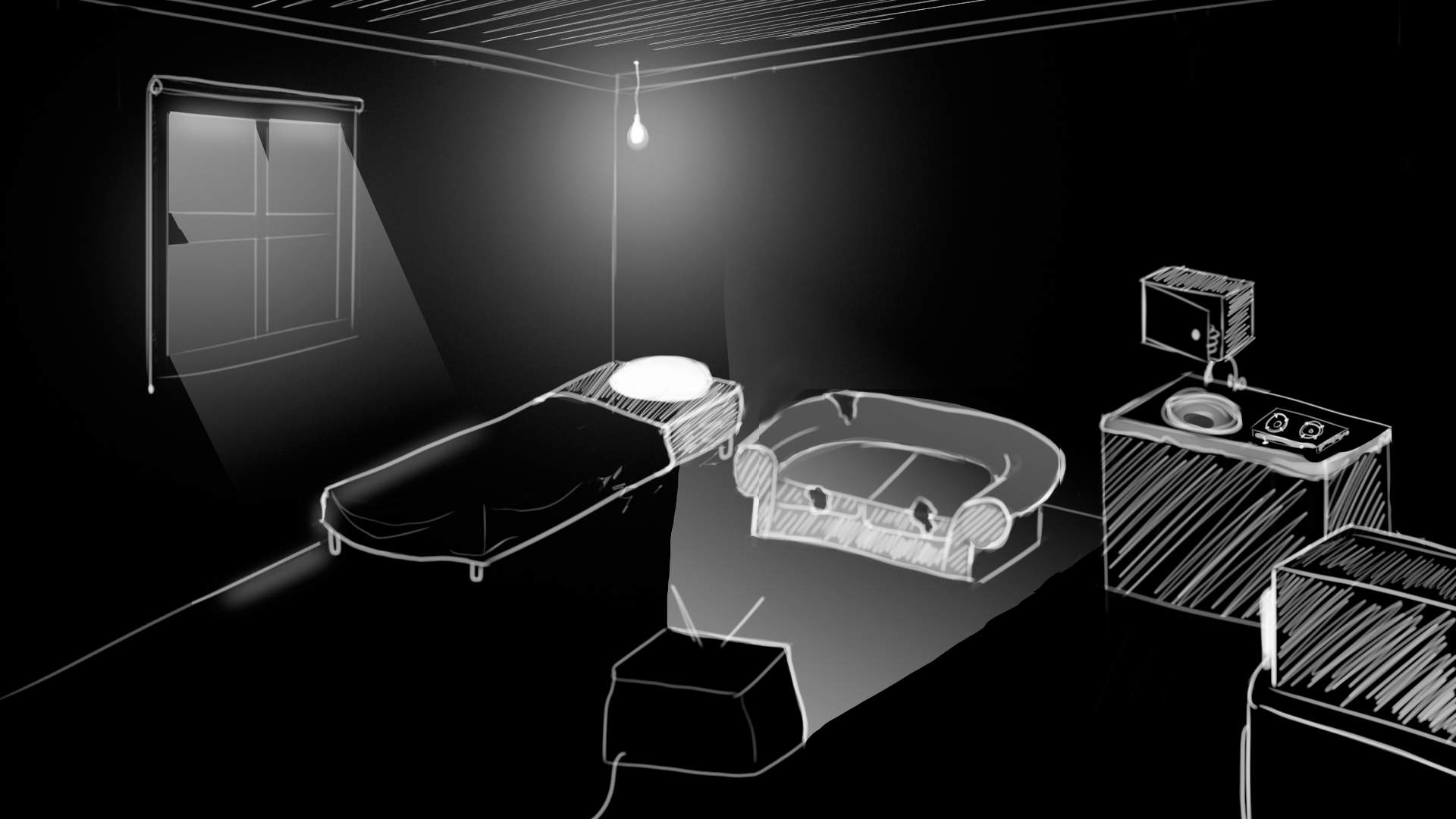
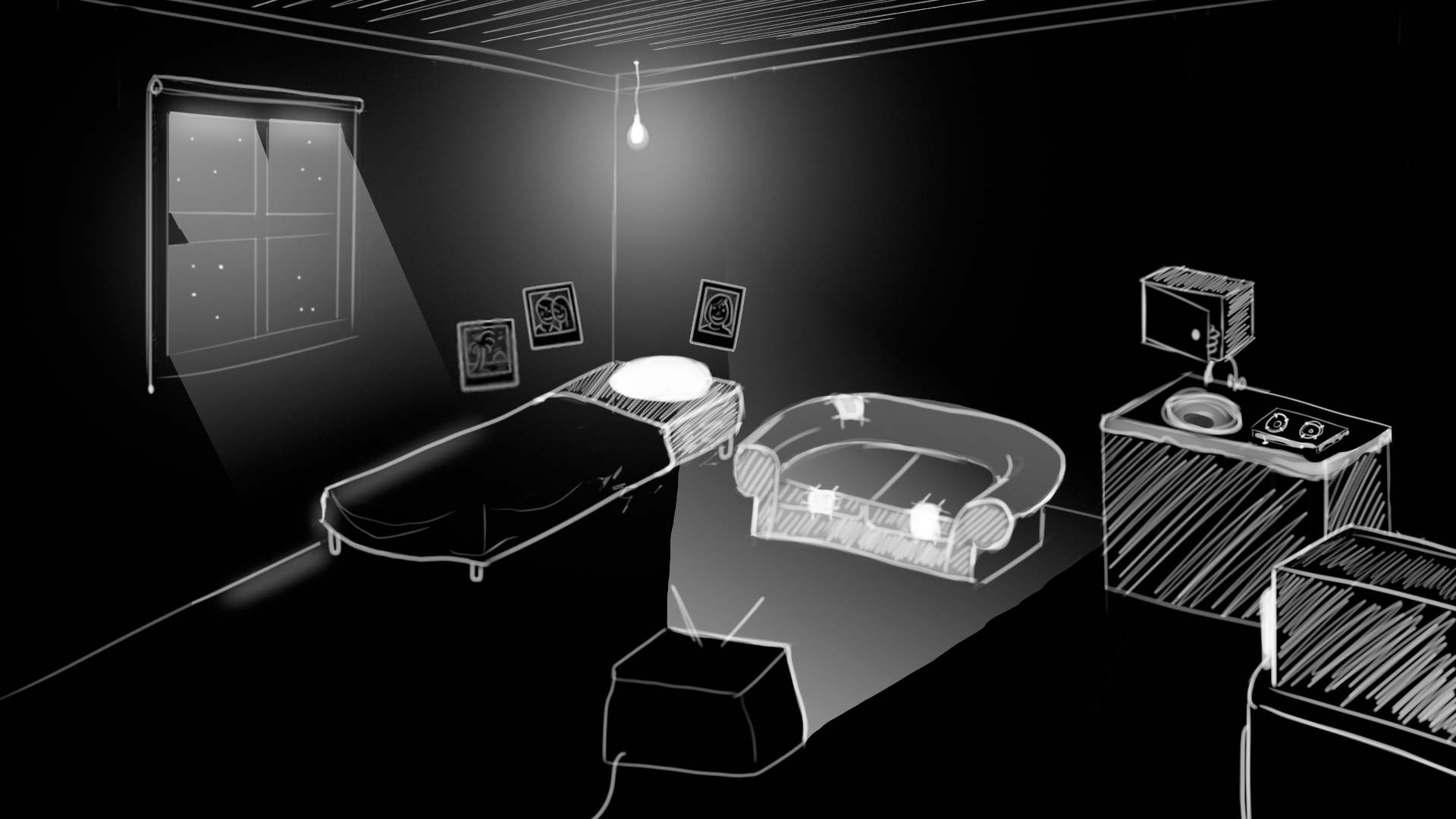
I also wanted to add some visual progress to the images of the house so players would see the image changing as they cleaned (eg the bed would become made). The artist had originally given me one overall finished image for the main room, but I needed to create steps for each element as well as create updates for the kitchen. For the main room, I copied each side of the room from the finished artwork. I then pasted each on top of the messy room and used smuge, blur and a very diffused paint tool to help make the lighting match. I also created some photographs to paste on the wall around to bed to reflect text about the player hanging them up. I used the blur tool on these to soften them and make them match the sketchy art style of the existing art. I also added a few dots to represent stars in the now-open window.

Original messy room:
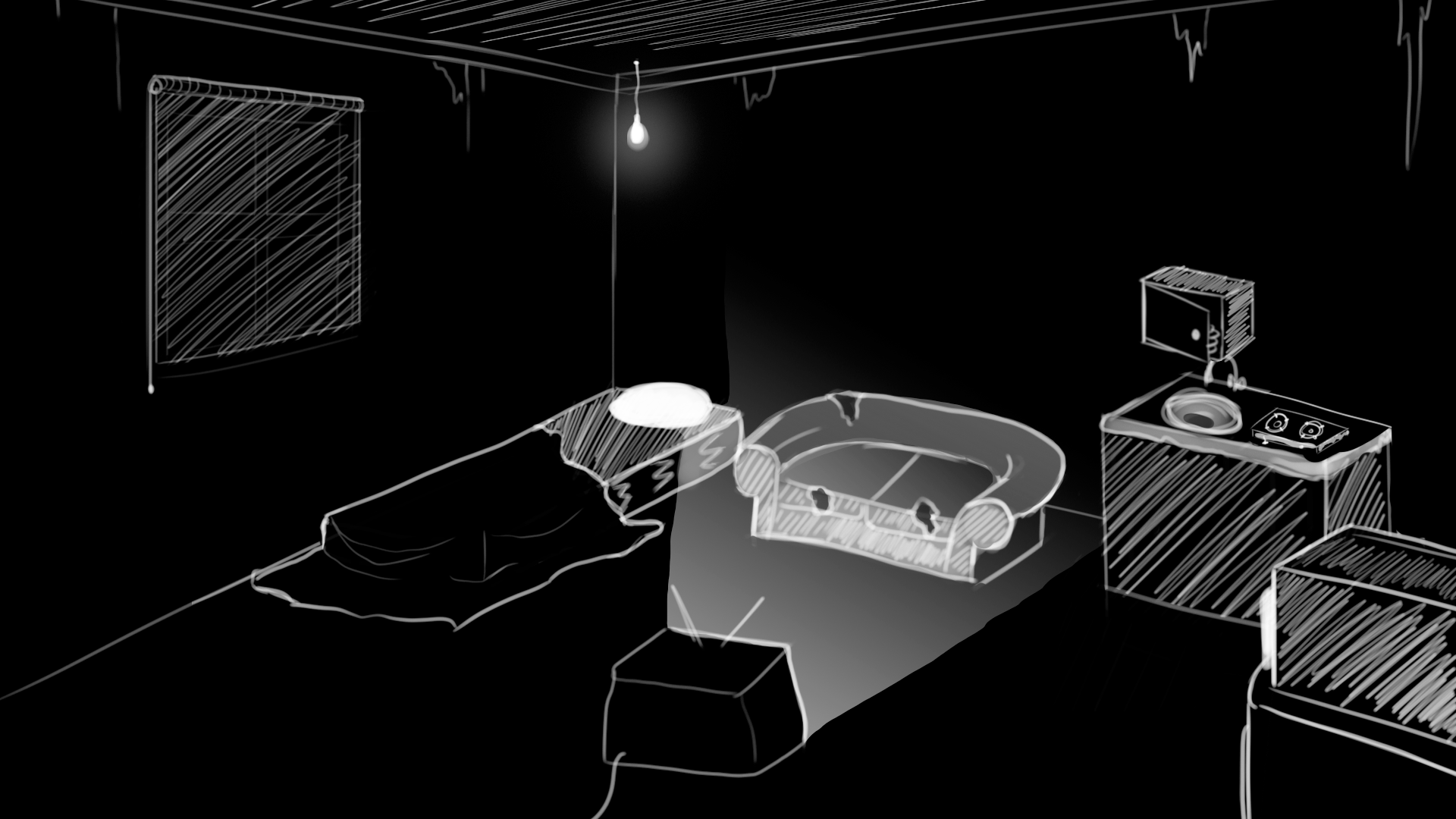
Bed made, couch still torn (there’s an equivalent for couch repaired and bed still messy):
Final cleaned room:
For the kitchen, it was a lot easier. I just carefully erased away the dishes in the sink and drew in an arc to represent the bottom of the basin, and erased smuges on the stove. I added the same photos that were hung around the bed along with some basic shapes to represent magnets, and tada, fridge was transformed.

Some similar tweaking was done for the final page before the ending, where the player faces the final demon: their own reflection in the mirror. I used the existing image from the TV achievement (which is…a TV screen), filled in the outline around the screen, erased the antennas, and added some parallel diagonal lines to represent light reflecting off the mirror. It’s not amazing, but it’s functional enough to do the job!


Audio Updates

I added a few more songs to the playlist, retaining the theme of classical piano. Finding these gave me a nice mental break between working on other parts of the project.

I also found several different audio snippets of pages turning, to have the sound match the new “journal” style UI. The code below defines the names of the audio events and randomly shuffles plays one whenever parts of the game are clicked.

setup.audio = {
  pageturn: ["pageturn1", "pageturn2", "pageturn3", "pageturn4"]
}
$(document).on('click', 'button, a, .clickable', function () {
    Wikifier.wikifyEval('<<sf>>');
});
<<widget "sf">>
<<set _click = setup.audio.pageturn.random()>>
<<audio _click volume .3 play>>
<</widget>>

Writing Updates

A large chunk of time was spent on this. Our original game was very black-and-white (teehee) in how we portrayed the player’s relationship with their mother. She was basically this flat, one-dimensionally evil character – but that’s not how real relationships or people are, so I spent a lot of time fleshing out nuances of the relationship through memories. 

I added a dad and obliquely hinted that he had passed away, which changed the dynamic between mother and player and led to the shift in the mother’s behavior. I enhanced this by using seasonal references to indicate what part of the memory timeline the player is recalling, cycling from summer to winter and back into summer as the player left home to try to find their own happiness at culinary school.

  dolmaMemory: [“You remember how one summer all of you took a family cooking course. Dad had roared with laughter as he watched the mess you made trying to roll dolma together with your chubby fingers, before scooping you into his lap to help guide your efforts. Mom had kissed him on the head and tenderly squeezed your shoulder…You suddenly find the thought of the dish unappealing as you imagine some other kid learning to make it, some other child having what you lost.”],

 breadMemory: [“You are struck by a bittersweet memory of making bread with your mother. That day was one of the few great ones you can remember with her. It was autumn, the air chill and crisp, before dad’s test results kept getting worse. You slathered the crusty slices with butter and dunked them into a hearty chicken soup, a cozy meal against the gathering storm. Was it your fault that everything changed?”],

  beignetMemory: [“Snowflakes mounded soft as sugar outside the hospital that day near the end and the sky was a blueberry bruise. You reflect on how the ugly can nestle among the most beautiful moments – the discordance makes your head spin and you catch yourself nervously glancing towards the window, as if reassuring yourself the day outside is appropriately gloomy.”],

lemonTartMemory: [“You’ve always loved lemon desserts. There’s something about the light citrus that is always refreshing. You remember one sun-drenched spring day, not long after dad was gone: your group of friends rode bikes to the store, pooled pocket money, bought a box of cookies and gorged. Powdered sugar smiles beneath cotton-candy clouds – worth the stomach ache that night to forget the feelings for the afternoon.”],

  eggrollsMemory: [“You can’t help but crack a bittersweet smile, remembering one group outing after culinary class let out for the summer break when a crowd of you went out for dim sum and bonded over boldly trying everything on the menu. Cart after cart rolled by, depositing steaming baskets of dumplings, fried morsels, delicate desserts, and your stomach swelled, aching from overeating…but moreso from laughter. It was a good day.”],

The overall goal was to create a deeper, more emotionally rich story with room for sympathy for the maternal figure while enhancing the pathos for the player’s character.

Overall

All in all, I’m happy with my updates!

I think one important takeaway is recognizing scope and limiting it where needed to ensure something complete is produced, instead of endlessly tinkering. This is, at the end of the day, an experimental art project – it’s not something I’m going to sell so it doesn’t need rigorous polish or expansive gameplay. It’s updated enough to look slick and the gameplay and story have been expanded enough to tell a well-rounded, self-contained narrative.

Could this be better? Sure, but what I’ve produced is definitely a clear sign of my progress in both my health/brain recovery and in my growth as a dev – which seems pretty fitting, given it’s a game about moving past trauma through constructive choices. I certainly did some constructing! 

Check out the game here: https://loressa.itch.io/succor
Share this:

  • Share
  • Click to email a link to a friend (Opens in new window) Email
  • Click to print (Opens in new window) Print
  • Click to share on Facebook (Opens in new window) Facebook
  • Click to share on X (Opens in new window) X
  • Click to share on Tumblr (Opens in new window) Tumblr
  • Click to share on Reddit (Opens in new window) Reddit
Like Loading...

Newb Moments

17 Thursday Jan 2013

Posted by abc in Game Psychology, MUDs, Social, World of Warcraft

≈ 2 Comments

Tags

gaming, MUD, MUDs, newb, newb moments, newbie, text game, WoW

The following comment from a WI article started reminding me of some of my biggest newb moments.

Daniel said: If quest healing, also remember not to modify your attacks to the alt key! Alt+tab when questing may end in disaster.

You see, I use keybindings a lot for my healing, especially for instant cast spells. Probably a development of all the PvPing I did during my formative levelling. I soon realized that I ran out of keys to use, so I use modifiers quite often.

#showtooltip penance
/cast [mod:alt, target=focus][mod:shift, target=target][nomod, target=player] penance

That’s a simple use of modifiers in a macro. You press different buttons and different things happen. You can use these quite potently…or otherwise…

I, personally, have alt set as my modifier for directing my spells to my tank. Ie, I press 1, I bubble myself. I press alt+1, I bubble the tank. Well, I was raiding on my paladin and we were in Bastion of Twilight at that REALLY nasty trash pull with all the elements, right before the Captain Planet fight.

Now, at this past point in time, I have my hands (eg of protection, salvation, etc) lined up on my F keys to keep track of them really easily (you may see where this is going), but when I try to hand of sacrifice the tank, my game crashes!

“Omg!” I growl into mumble. “Wait, sorry, ack, stupid game crashed!”

I log back in to see that everyone has wiped. Sadface. We run back and try again. Again, I attempt to hand of sacrifice the tank. Again, poof! WoW closes.

“OMG! This spell is making my game crash!!!” I log back in, righteously pissed off at Blizzard by this point, and finally one of my teammates jokes, “Geez, what are you doing? Pressing alt+f4 over and over? Lawl!”

Oh. Duh. I mumble something about bugs as I furtively move hand of sacrifice off of the F4 key.

Apparently I’m not the only one who was reminded of newbiness, as today’s WI breakfast topic is a  wonderful collection of amusing raid-based failure. I highly recommend a read.

Some runs back are longer than others...

Some runs back are longer than others…

“Newb moments,” to me, are something longer-lasting than a simple blonde moment or brain fart. They are almost a sort of epiphany, moments where you discover something fundamental and profound – except in this case, that discovery is something you really should have known about.

My very first memory of a newb moment was when I initially began playing MUDs, over a dozen years ago (ugh, I feel so old saying that). I remember reading the game’s website and imagining how I could become an amazing, powerful….something. I wasn’t that clear on how it all worked. Eager to become awesome, I set off exploring.

Now, I had played other games before this. I had a Sega Genesis as a kid and even before that we had an Atari ST (it was the Cadillac of prehistoric PCs kthnx). Even better, we had internet access before the internet was even a fully-fledged thing. This meant that we got, in addition to all the important boring government DARPA defense stuff, SHAREWARE (and demo) GAMES!!!

While some of these games were amazing displays of graphics and sound like TURRICAN, some were little freeware ditties, including a range of text games: virtual trucker games, a Clue knockoff and Zork-esque adventures. The text adventures, in particular, resonated with me, and I spent many an hour trying to “get dragon” and “kill dragon” (and lots of subsequent “you have died”ing).

So, when I got older and we got ourselves a fancy new computer and super fast internet – the phone jack went STRAIGHT INTO THE COMPUTER!!! – I started looking at what games were out there on the web and found a game called Avalon. Fast-forward to my imagined ascent to greatness.

Oh boy. Telnet.

Oh boy. Telnet.

I explored the virtual world, merrily typing north, north, east, look, get dung – you know, the usual. I discovered things all over that I could pick up. I found a whole castle on top of a mountain filled with dwarves! I got lost in the caves under the castle and got killed by an orc. I dropped all of the awesome shinies I had been carrying. Le sigh. A roadblock on my path to becoming amazing!

It didn’t matter. I was enthralled. I played for hours straight, and then again the next day. And at the height of this enraptured gameplay, something happened – the newbiest newb moment of all newb moments – that changed my paradigm on games completely.

I was still caught up in my voracious exploring and questing when I wandered into a building that appeared to be a temple. The rooms had vaunted names and the text descriptions detailed columns and ornate carvings. I felt a shiver of apprehension. Was I nearly at the part where I became the ruler of the world?

I came upon a dead end. There, standing out in bright aquamarine text, was what had to be part of my ultimate quest: “Archimedes, the God of Wisdom.” Normal quest creatures weren’t named in colors that brilliant. Normal quest givers didn’t have names that illustrious. Normal quest givers didn’t hang out in a sacred temple. Exhaling slowly, I readied myself for the final task and then typed in the phrase I had learned would prompt the game’s creatures to give me quests – GREET ARCHIMEDES.

You warmly greet Archimedes, the God of Wisdom.

I waited, breath bated.

And kept waiting. Weird. The other creatures always gave me quests instantly.

GREET ARCHIMEDES.

You warmly greet Archimedes, the God of Wisdom.

Still nothing. I was getting frustrated.

GREET ARCHIMEDES

GREET ARCHIMEDES

GREET ARCHIMEDES

You warmly greet Archimedes, the God of Wisdom.

You warmly greet Archimedes, the God of Wisdom.

You warmly greet Archimedes, the God of Wisdom.

Archimedes, the God of Wisdom lets out a broad chuckle.

Archimedes, the God of Wisdom says, “Quite the persistently friendly one you are, aren’t you?”

GET QUEST FROM ARCHIMEDES

Archimedes, the God of Wisdom says, “Are you lost? Need some help on your novice quests?”

NOVICE

NOVICE commands are the province of the Ministry of Public Relations and the barony.

Ok, what did that mean?! All of a sudden this game was getting confusing.

Theresa appears before you through the black screen of a magical portal.

Whoa.

“Hi!” Theresa happily says.

Theresa says, “Lost novice here?”

Archimedes, the God of Wisdom nods emphatically.

Theresa says, “No worries. I’ll help her out.”

Theresa says, “Follow me. Just type FOLLOW THERESA.”

WHOA.

Suddenly it hit me – these were not computer creatures. THESE WERE REAL PEOPLE. There were other people playing the game with me. The world fell out beneath me. I had been completely oblivious to the vast, expansive nature of the game I was playing…oblivious to the potential of the internet itself. I was in a fantasy world inhabited not just by monsters and dragons, but also by other living, breathing people. All on my computer. The realization was astounding.

This, here, was my newb moment, when I discovered I had been overlooking an essential element of the game. In my case, I had missed the fundamental nature of what a MUD was – a multiplayer dungeon.

Once that awareness sunk in, the game was never the same.

On one hand, a whole new vista of gameplay unfolded. Player-to-player interactions are far more complex and ever-changing than scripted AI. Roleplay develops, alliances form, enemies are made. Combat is intense and politics compelling. The game develops endless playability.

Then again, there is something vital lost in that awakening. It’s like a kid realizing that (spoilers!) Santa doesn’t really exist. Yes, you see the more complex mechanics of the gameplay (or reasons for the holiday) and learn to play at a deeper level (ie be a grown up), but there is still an element of blissful ignorance that has been shed. What started as an impossibly engaging magical experience establishes itself as just a game.

Any level of competent gameplay requires this transition (which is probably a better topic for another entry, as this one is getting rather long). Sometimes, however, I look back on this first massive newb moment, and nostalgically remember what it was like to be clueless.

How about you? Any incredibly huge blind spots you’ve discovered in your gameplay? Any big discoveries? Any reaaaaaally stupid mistakes you’ve made?

Share this:

  • Share
  • Click to email a link to a friend (Opens in new window) Email
  • Click to print (Opens in new window) Print
  • Click to share on Facebook (Opens in new window) Facebook
  • Click to share on X (Opens in new window) X
  • Click to share on Tumblr (Opens in new window) Tumblr
  • Click to share on Reddit (Opens in new window) Reddit
Like Loading...

Low Res Gaming

02 Wednesday Jan 2013

Posted by abc in Game Design, Game Psychology, World of Warcraft

≈ Leave a comment

Tags

crappy graphics, gaming, videogames

I was reading the Queue, WoW Insider’s daily reader Q&A, and this question (and the TONS of debate in the comments) stood out to me:

Daniel asked:

is the increasing size of the game killing subscribers with inferior machines?

No. WoW is still very accessible from very aged computers. The size of the game has very little to do with any as well, as long as the graphic settings are low the game could be three times the size it is right now and it’d still function fine.

It’s a fairly relevant topic for me. You see, I don’t have a video card. In Guild Wars 2, I joke that I have a super deluxe in-built realistic physics engine. My friends all kinda raised their eyebrows, until they saw my computer at our New Years’ GW2 LAN party: every time I ran anywhere, my turns would translate momentum from the direction I had been travelling in and if I stopped running my character would jog a step or two before fully halting. It makes doing jump puzzles impossible, but it actually does add an (inadvertent) layer of realism to my toon’s movement. Still, it’s crappy graphics. The game looks pixelated and grainy, and WoW – while less demanding – is often hardly better.  I run at about 10 fps in raids. All of my settings are as low as low can be, except for view distance in battlegrounds (hey, I gotta be able to see Gold Mine from Lumbermill!).

I’m also my guild’s top healer. Granted, we’re not a hardcore progression team, but we did just down the first boss in Terrace, so we’re not a throwaway guild either. My game is not as pretty as…pretty much anyone else’s…but, to be honest, I find that helps half the time for avoiding crap on the ground. I used my live-in-arms-warrior’s computer while he was back east visiting family and I was dazzled and almost a bit overwhelmed by all the shiny, pretty, glaring spell effects. I may be part magpie. However, I can see the merit of toning all that down (except for certain encounters, like BoT’s Valiona which had to be hotfixed so low graphic settings could even SEE the black circles) to make it easier to see the really vital stuff, like void zones.

Plus, if you have really shitty graphics, it makes gathering quests (and sometimes PvP) cool in an almost-cheating-it’s-kinda-that-great way, since all the ground clutter phases out of view unless you are right on top of it. This means that you can essentially see through the world and view the actual quest elements and other players. Boxes, rocks, plants – bam, gone! Great for things like hunting for cloud serpent eggs; all the foliage vanishes, but the eggs are interactable objects, so they remain visible.

I mean, really, what stuff IS actually important to see? As a priest, I like being able to see who has bubble and aegis at a glance, but that’s really only vital in PvP (both for keeping them ON my team and for dispelling them FROM enemy teams!). In raids, I tend to be keeping my eyes more on health meters, however, and those display who’s got bubble AND  how long their weakened soul is. I don’t really NEED to see my spells themselves being cast. Now, don’t get me wrong, it’d feel weird if my character just sat there, but seeing sparkles shoot out of my hands is not necessary to gameplay – all I really need from that end is a cast bar to let me know that spells are actually being cast. Technically I don’t NEED the visuals of it.

However, there’s a reason gaming moved on from text-based into graphical, afterall (hint: it involves the graphics). A game where all of the visuals are pared down is not an aesthetically pleasing one. Think about it – when you picked up your first MMO, there was probably a moment of awe, simply based on what you were seeing. I know there was for me: I came to WoW from text-based MUDs and to suddenly SEE all of the game in dancing, vibrant colors and 3-d image was jaw-dropping.

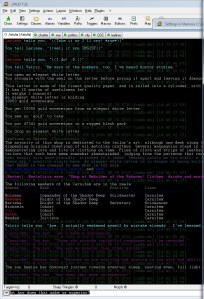
mudscreen

General MUD gameplay. Talking to another player and viewing /g

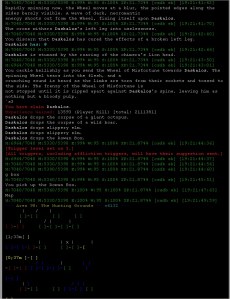
mudscreen1

MUD combat and part of the in-game mapping system

mudscreen2

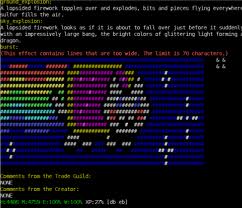
An ASCII firework!

Those above? That’s what a MUD looks like. You might get some ASCII image, like the “map” at the bottom of the second (yes, we use THAT to navigate) or even some more flashy things like ASCII fireworks of a nyancat. However, that’s as advanced as you get, graphically. It’s like being stuck in 1980, visually, in a MUD. So to suddenly load WoW and SEE my character (instead of just imagine her) and SEE her casting spells…that was incredible. It’s not much of a leap to assume that it was a similar experience for many people trying MMOs for the first time, and there is no doubt in my mind that part of what makes a game popular is its graphics – but very firmly only part.

Graphics alone don’t make (or break) a game. RIFT, for example, had stunning graphics, but a lack of distinctly unique gameplay prevented it from becoming the WoWKiller it was predicted to be. Many Asian MMOs have gorgeous graphics, but overly-grindy (to Western audiences) gameplay prevents them from getting a foothold in the US and EU market. On the other end of the spectrum, you have the runaway success of Minecraft and its 16-bit world.

In my opinion, it comes back to that first experience I had with WoW. Not only was I seeing the game world, I was seeing MY character. I had given her red hair, like me, and, to this day, I remember what it looked like to watch her run around and cast spells. I identified with my avatar and formed an attachment to her visual representation. Now, that kind of visual identity transcends whether the game even has graphics; it’s just easier in an MMO. In MUDs,  many players went out of their way to visualize their characters: avatars and signatures for forums, a paragraph describing how the character looks, even real life drawings to depict the character. One of the biggest ways to make money in the IRE games, for example, is drawing pictures IRL for other players. I know, personally, because I had DOZENS made of my little Imp.

The difference between a MMO and a MUD is that the ENTIRE world is there for you to see in a MMO. In a MUD, you have to imagine the game world, and immersion stems from other sources, such as reading the description of a room, or reading what an NPC says, or reading another character’s emotes (it involves a lot of reading, is what I’m getting at). In a MMO, it’s right there before you. You drink it in and are instantly immersed;  that type of game magic is what drew so many to try out MMOs and shot the popularity of multiplayer games from the thousands into the millions.

…but at the same time, that quick, in-your-face immersion dulls you to its very power.

In a MUD, you are drawn in to the story and the mental pictures you, yourself, are painting. That doesn’t mean that you read the text for every time you cast a fireball. It’s the same line of words, and you cast hundreds of fireballs every time you go out grinding. You tune it out, just as MMO players tune out basic cast animations to focus on what is DIFFERENT. It’s the same concept of our brain tuning out white noise or ignoring the sight of our own nose in front of us. Basically, stuff that is repetitive and the same gets relegated to the back of our notice, so we can pay attention to changes.

I’d argue, however, that after a point, the very gameworld becomes background noise. When you are raiding or capturing a flag, you aren’t focusing on the cool architecture of the room or the pretty trees surrounding the base. You are looking on the ground for void zones or watching an enemy cast bar for polymorph. MUDs are similar: when you first start playing you walk around reading every room description. Eventually, you just turn on BRIEF and get just the name of the room and the exits as you run around the game.

Verbose and then brief room descriptions in a MUD

Verbose and then brief room descriptions in a MUD (my spaceship in Lusternia)

In short, you focus on the game’s mechanics and gameplay, and the immersive aspects (like graphics or descriptions) only really factor in as an occasional “yeah, that’s nice” or when you consider how well they are letting you see stuff like enemy AoE. In both cases, there are definitely moments where you can be drawn back into the game world. It might be a particularly beautiful vista in WoW or an especially unique room name in a MUD prompting you to read the room’s description. And some players who are focused heavily on roleplay may not even leave the heavy immersion behind in the first place. But the majority of players tend to concentrate on the gameplay itself when involved in tasks like raiding or PvP. I guess I’m saying that graphics don’t really matter for core gameplay, as long as they are good (and fast) enough to let you see what you need to. Having graphics, period, has helped draw many new players to MMOs, but having insane graphics won’t make up for subpar mechanics or design, because players become essentially immune to the visuals when they are engrossed in high-attention gameplay.
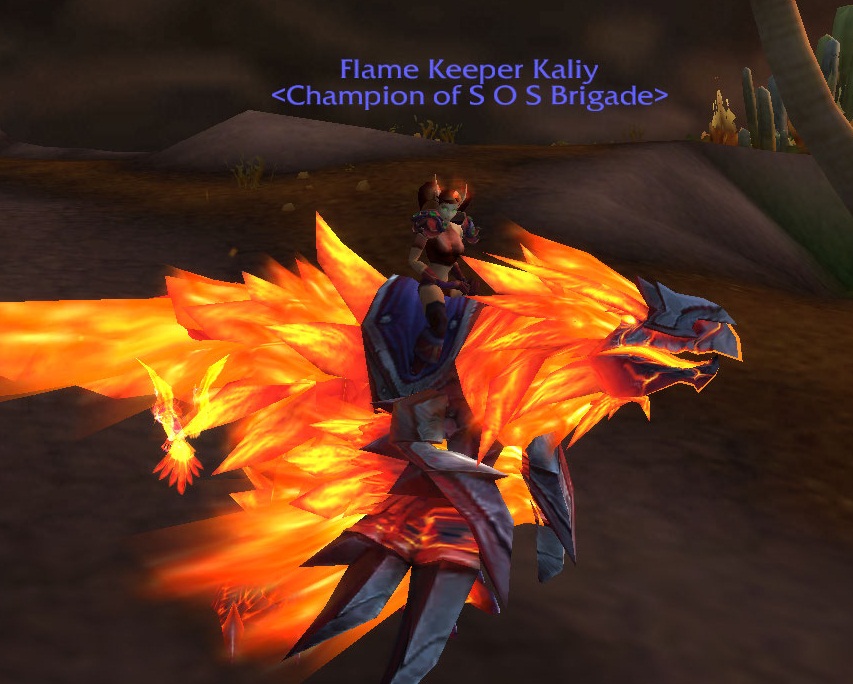
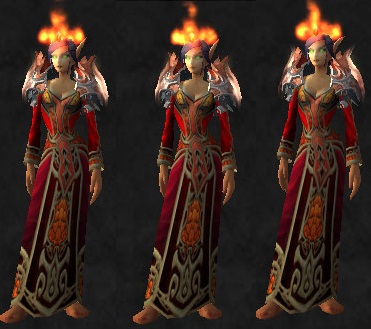
All of the above being said, playing low graphics does make for some amusing anecdotes. For example, when xmog came out, I said I wanted a halo or a crown or something pretty, so a guildmate took me to BRD and I got the Circle of Flame. “Oooh!” I thought. “A red gem hanging above my head!” and proceeded to xmog every outfit ever with it for a year or so.

flame_kal

See? There’s a little red gem hanging over my head! (Squint your eyes and zoom in; it may help) Then, a few weeks ago, I came to bug my boyfriend’s toon by mimicking him as he ran around doing stuff (we’re mature adults like that)…and I completely froze, staring at his screen.

“What…what is that?!” I stammered.

“What is what?” he replied, turning to face me in real life.

I pointed at his screen. “That!” I exclaimed, circling my toon’s head on his screen. “My head is on FIRE!”

He stared blankly back at me. I mean, I’m a goof, but I think he was a bit concerned.

“It’s…your…armor…?” he suggested.

“Since WHEN?!”

Turns out, the actual visual for the circle of fire is – shockingly – a circle. Of fire. Go figure. After a few minutes of being weirded out by my (from my view) new wreath of flames, I decided I liked the look quite a bit, and began demanding that he show me myself just so I could admire my toon in high res. In a way, I feel like I’m back at square one, knocked out of my jaded function-over-form paradigm from the last few years to find myself enthralled simply by the image of my character, shining away like a pretty little pyrotechnic elf.

Pretty fire....

Pretty fire….

…Damn. Now I want a video card, and Christmas JUST passed.

Share this:

  • Share
  • Click to email a link to a friend (Opens in new window) Email
  • Click to print (Opens in new window) Print
  • Click to share on Facebook (Opens in new window) Facebook
  • Click to share on X (Opens in new window) X
  • Click to share on Tumblr (Opens in new window) Tumblr
  • Click to share on Reddit (Opens in new window) Reddit
Like Loading...

YAY! I WRITE STUFF!

A blog for random discoveries, musings, feedback and ideas about gaming, fantasy and life. And probably kittens. I love kittens.

Just type in your email and get it all in your inbox. SO EASY OMGYAY!

Join 21 other subscribers

RECENT POSTS!

  • Fodder October 3, 2025
  • Sleeping Body September 25, 2025
  • Revolution of Sound September 25, 2025
  • Microwave September 25, 2025
  • Eternal Teaparty September 25, 2025

ORGANIZATION AND WHATEVER!

TYPE IN WORDS HERE TO FIND THINGS!

VISIT THE PAST ARCHIVES! OOOOOOH MYSTERIOOOOUS TIMEY WIMEY STUFF!

PEOPLE SAYING THINGS IN COMMENTS!

Shanthi's avatarShanthi on Back to MoP
abc's avatarabc on Back to MoP
Unknown's avatarDisc Priesting for T… on Spirit shelling your way throu…
Shanthi's avatarShanthi on Back to MoP
Unknown's avatarSo I flipped 6500 ca… on Living steel

I AM LEARNING TWITTER! :D

Tweets by jjloraine

STUFF I LIKE TO READ!

  • Super Shock Gaming Zone
  • Ray Ferrer - Emotion on Canvas
  • Edge of Humanity Magazine
  • a little bit of everything all of the time
  • Crafts Thrill
  • What's Your Tag?
  • And fallen, fallen light renew
  • Reputation Grind
  • Superior Realities
  • The Warchief's Command Board
  • Under Construction
  • Be MOP

Blogroll

  • Admiring Azeroth Great screenshots and pet battle info.
  • Bakuenryu! Awesome series about leading a raid team
  • Be MoP A student’s look at the latest expansion
  • Doomed…ish Write-ups of my D&D fun.
  • Holy Word: Delicious Priesting stuffs
  • Info from Nightwill the Altaholic A great general info blog, with a focus on roleplay, lore and creativity.
  • Lair of the 4-eyed Monster D&D and art blog
  • MMO Melting Pot Summaries of the best MMO blog posts of each day!
  • Notes from a Burning House Personal Reflections and Flights of Fancy
  • Orcish Army Knife Great writing on general WoW, with awesome lore posts.
  • Psychochild A developer’s musings on game development and writing.
  • The Warchief's Command Board Thoughts and Musings from Garrosh Hellscream (HILARIOUS parody blog!)

Meta

  • Create account
  • Log in
  • Entries feed
  • Comments feed
  • WordPress.com

Blog at WordPress.com.

Super Shock Gaming Zone

Super Shock Bundle

Ray Ferrer - Emotion on Canvas

** OFFICIAL Site of Artist Ray Ferrer **

Edge of Humanity Magazine

An Independent Nondiscriminatory Platform With No Religious, Political, Financial, or Social Affiliations - FOUNDED 2014

a little bit of everything all of the time

Thoughts on stuff and things.

Crafts Thrill

What's Your Tag?

Video Games, Comics, and Shenanigans.

And fallen, fallen light renew

An ongoing fiction.

Reputation Grind

It doesn't end at exalted.

Superior Realities

The Warchief's Command Board

Under Construction

Be MOP

  • Subscribe Subscribed
    • a little bit of everything all of the time
    • Already have a WordPress.com account? Log in now.
    • a little bit of everything all of the time
    • Subscribe Subscribed
    • Sign up
    • Log in
    • Report this content
    • View site in Reader
    • Manage subscriptions
    • Collapse this bar
 

Loading Comments...
 

    %d